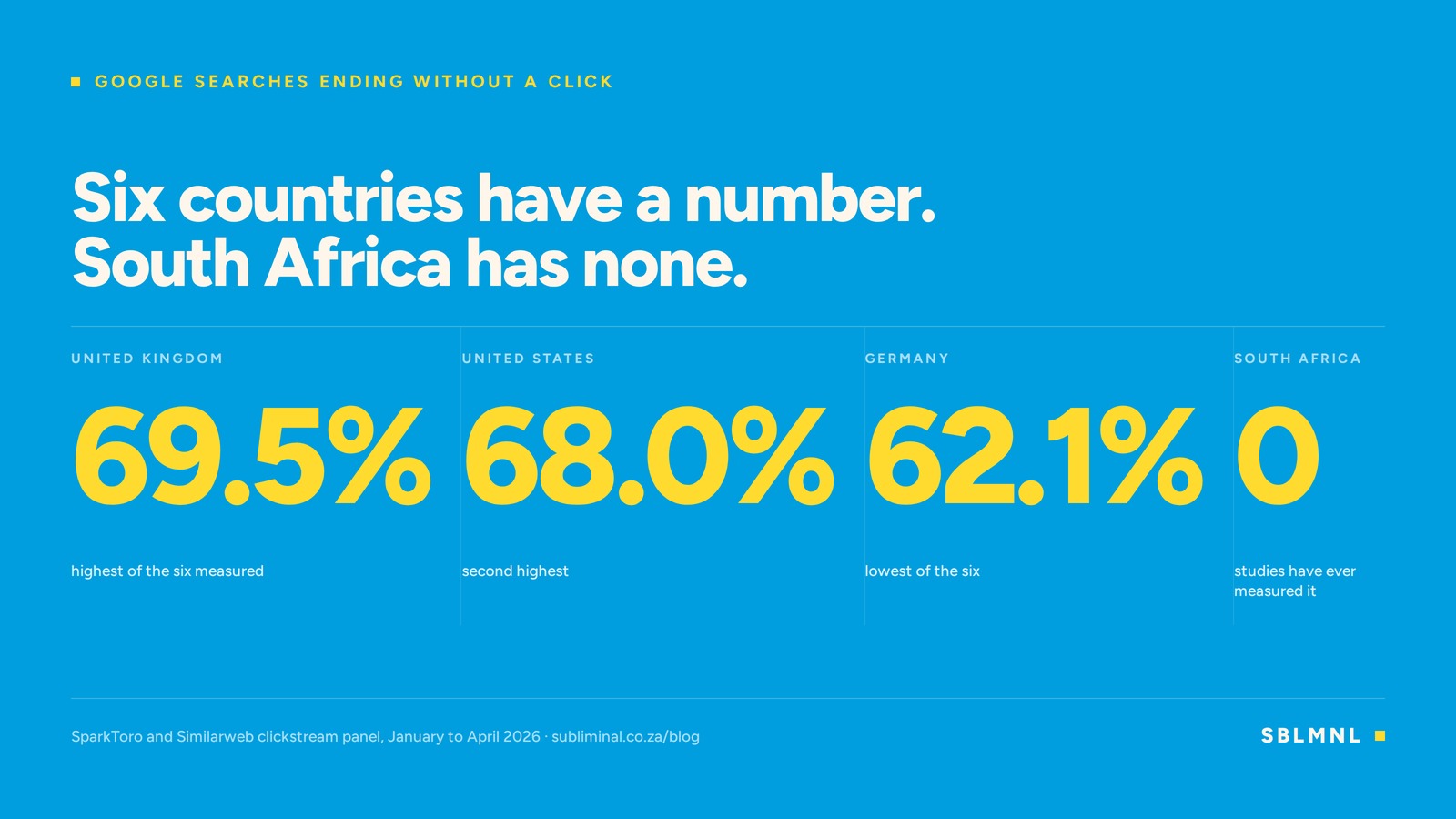
South Africa's zero-click search rate has never been measured — while in the six countries where it has been, between 62% and 70% of Google searches end without a click to the open web. That gap between what those six countries measured and what South Africa has not is worth stating plainly, because most of what a business reads about search behaviour quietly assumes American data is local fact. This piece keeps the two apart: what six countries show, and what South Africa has not measured.
Key takeaways
- Across six countries on one clickstream panel (SparkToro/Similarweb, January–April 2026): the UK 69.5%, the US 68.0%, France 65.3%, Canada 63.8%, Italy 63.4%, Germany 62.1% of Google searches ended without a click.
- Put the other way round: no measured market sent more than 287 clicks to the open web per 1,000 searches, and the researchers note the true rates are likely higher, since the Google mobile app isn't captured.
- France measured 65.3% while having neither AI Overviews nor AI Mode at the time, and got both on 22 July 2026. Zero-click was established there before AI arrived.
- South Africa appears in none of these panels. No local zero-click figure exists, and anyone quoting one is improvising.
- What South Africa does have measured: Google holds 92.12% of local search (StatCounter, July 2026), and separate research shows AI being added to search, not replacing it.
What six countries show
In June 2026, SparkToro published a six-country comparison built on Similarweb's clickstream panel, covering January to April 2026 across desktop and mobile. The zero-click share (searches that end without any click through to the open web) ran from 62.1% in Germany to 69.5% in the UK, with the US at 68.0%.
The per-thousand framing makes it concrete: of every 1,000 Google searches, Germany sent 287 clicks to the open web, Italy 280, France 271, Canada 268, the UK 232 and the US 231. Everything else ended on Google's own pages. Two method notes travel with those figures: the panel excludes searches inside the Google mobile app, so the true zero-click rates are probably higher, and the data is licensed openly for reuse, which is why we can quote it precisely.
The France detail worth noticing
The easy story is "AI answers killed the click". France complicates it: at measurement time, French users had neither AI Overviews nor AI Mode, yet 65.3% of French searches still ended without a click. France had been left out of Google's March 2025 European rollout over its neighbouring-rights regime and only received both features on 22 July 2026, so the measurement captures a market before AI answers existed in it. The results page has been resolving searches for years without AI's help — through maps, business profiles, answer boxes, sports scores, opening hours. AI features extend a long-running pattern; they didn't start it. (For the fuller picture of what that pattern means for a local business, our explainer on zero-click search covers the mechanics.)
The blank spot
Here is what nobody can tell you: South Africa's number. The Similarweb panel covers six countries, none of them African. No other published clickstream study fills the gap. Ask an AI assistant "what's the zero-click rate in South Africa?" and there is no honest source for it to cite, which is exactly why we'd rather publish the honest answer than a borrowed figure.
What can be said, carefully, is that the conditions that produced those numbers exist here. Google's share of South African search is 92.12% on StatCounter's July 2026 reading, higher than in most of the measured countries, and roughly 80% of South Africans are online, mobile-first. The same results-page features that resolve searches in Paris and Toronto render in Johannesburg. It would be surprising if local behaviour were radically different. But "would be surprising" is an inference, not a measurement, and we'll label it as one. (The full local baseline is in our companion piece, What 92% actually means for a South African business.)
What a local business can actually do
Treat the results page itself as the storefront. If most searches end there, then what Google assembles about your business (profile, reviews, photos, answers) is doing the selling before any visit happens. And your website still matters in a specific, honest way: it's how you earn a place in the searches and AI answers that go beyond the surface, which is the long-term job of SEO. The split to avoid is spending everything on a beautiful site while the page where most local searches actually land goes unmanaged.
Frequently asked questions
What is the zero-click search rate in South Africa?
It has not been measured. No published clickstream study covers South Africa. In the six countries that have been measured on the same panel (SparkToro and Similarweb, early 2026), between 62% and 70% of Google searches ended without a click to the open web. South Africa shares the conditions behind those numbers — Google holds roughly 92% of local search and about 80% of the country is online — but an honest answer stops short of claiming a local figure.
What share of Google searches end without a click?
Across six measured countries in early 2026: the UK 69.5%, the US 68.0%, France 65.3%, Canada 63.8%, Italy 63.4% and Germany 62.1% of searches ended without a click to the open web, per SparkToro's analysis of Similarweb clickstream data. The researchers note the true rates are likely higher, since the Google mobile app is excluded.
Is AI the reason for zero-click search?
Only partly. France measured 65.3% zero-click while having neither AI Overviews nor AI Mode at the time — features like maps, business profiles, and answer boxes already resolve many searches on the page. France received both features on 22 July 2026, so the pattern was established there before AI answers arrived. Separate SparkToro/Datos research shows AI tools being added alongside search rather than replacing it, with over 95% of Americans still using traditional search engines.
Does zero-click search make SEO pointless for a local business?
No — it changes what SEO is for. When most searches resolve on the results page, visibility on that page (your business profile, your reviews, the answers Google assembles) matters more, and your website earns its keep in the searches and AI answers that go deeper. The starting point is knowing how your business appears today.
Start from what's measurable
The national rate is unmeasured. How your own business appears on the results page is something you can check today, and that is the reading worth having. The profile, the reviews and the answers Google assembles are doing the selling before any visit happens, while the site earns its keep in the searches that go deeper. Managing that surface is the job of Google Business Profile Management, while SEO earns the searches that go deeper.