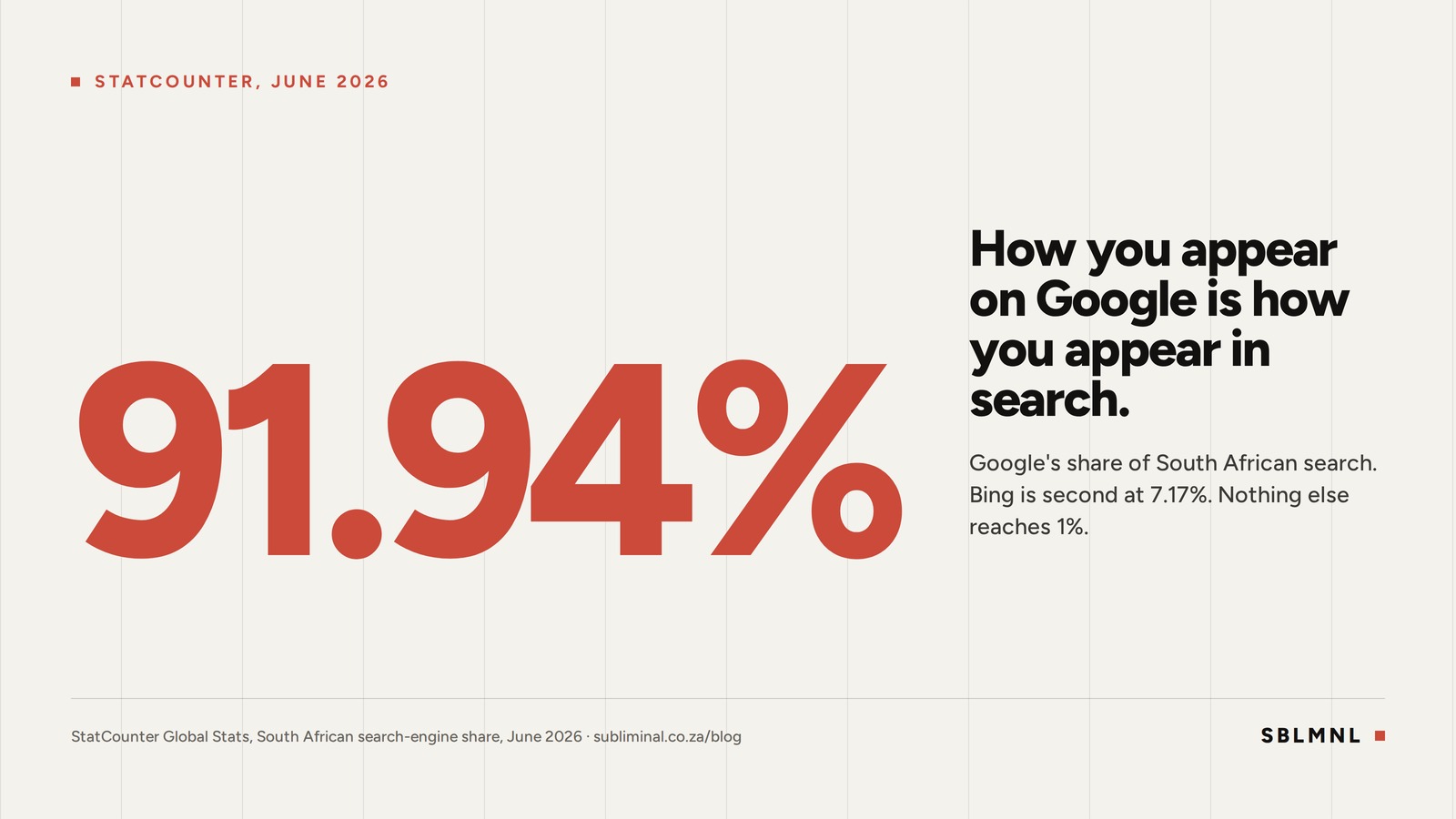
In South Africa, Google holds 91.94% of the search-engine market. So for a local business, how it appears on Google is, in practice, how it appears in search. That figure comes from StatCounter Global Stats for June 2026, and it is one of the most useful numbers in South African digital marketing, because it turns a vague instinct ("we should probably be on Google") into a measured fact about where customers actually look.
Key takeaways
- Google holds 91.94% of South Africa's search-engine market as of June 2026. Bing is second at 7.17%; nothing else reaches 1%.
- The share is easing, slowly: 93.46% in June 2025 to 91.94% thirteen months later, with Bing picking up most of the difference. Nine searches in ten still run through Google.
- About 51.7 million South Africans, roughly 80% of the population, are online, in a mobile-first market where cellular connections outnumber people almost two to one (DataReportal, reference date October 2025).
- South African online retail grew roughly 35% in 2024, to about R96-billion, while physical retail grew about 2.5%, by World Wide Worx's industry estimate.
- In the same World Wide Worx research, the share of SA online retailers rating search engine marketing as important to their success roughly doubled year on year, with a sample caveat worth reading before quoting.
Nine searches in ten
Start with the measurement itself. StatCounter tracks search-engine market share passively, from page views across millions of sites, rather than by asking people what they use. For South Africa in June 2026 it reads: Google 91.94%, Bing 7.17%, and a long tail of engines (Yahoo!, DuckDuckGo, Petal, Yandex) each below a third of a percent.
The share is not perfectly still. Over the thirteen months to June 2026, Google eased from 93.46% to 91.94% while Bing climbed from 5.73% to 7.17%. That drift is worth watching, and we'd rather show it than hide it. It does not change the practical picture: roughly nine in every ten South African searches run through one company's results page.
For a business owner, the useful translation is this. Every question a prospective customer asks before choosing you ("blinds installer near me", "best guest house in Parkhurst", "is this firm any good") is, roughly nine times in ten, asked on Google. The answer Google assembles, from your Business Profile, your reviews, your website and your ads, is your first impression, whether or not anyone clicks through to your site.
The market behind the number
A market-share percentage only matters if the market is big. It is. DataReportal's Digital 2026: South Africa report (published November 2025, reference date October 2025) counts about 51.7 million internet users (79.6% of the population), up a million on the year before. Mobile connections stand at 127 million, almost two per person, and DataReportal itself cautions that published internet-use figures "may under-represent current realities". Treat 80% as a conservative floor.
One comparison inside that report deserves more attention than it gets: social media identities number 29.1 million, a little over half the internet-user figure. Social reaches many South Africans; search, by these counts, reaches far more. For a business choosing where its visibility budget works hardest, that gap is a data point, not a slogan.
Where the growth went
Behaviour follows infrastructure, and the retail numbers show it. By World Wide Worx's estimate (with Mastercard, Peach Payments and Ask Afrika), South African online retail grew roughly 35% in 2024 to about R96-billion (about 8% of all retail), while physical retail grew about 2.5%. The study projects continued growth through 2025; projections deserve their own hedge, so we'd quote the measured 2024 figures and let the trend speak.
The sellers noticed. In the same World Wide Worx research, the share of South African online retailers rating search engine marketing as important to their success rose from 38.5% to 72.1% in a year. One caveat, which the report itself flags: the 2025 sample included more mid-sized and larger firms than 2024's, so part of that jump reflects who was surveyed rather than a clean change of heart. Even read conservatively, the direction is hard to miss — your competitors increasingly believe being found is worth paying for. That is peer behaviour, not a promise from us, which is exactly why it's worth taking seriously.
What this means in practice
None of this says "spend more on marketing". It says something more specific: in South Africa, visibility work concentrates on one surface, so the state of that surface is worth knowing precisely.
- Your presence in local results. For searches with local intent, Google assembles an answer from Business Profiles and reviews before any website is visited. An accurate, actively managed profile is the foundation, which is the job of Google Business Profile Management.
- Your visibility in organic results. A 92% search market makes the slow, compounding work of SEO a long-term asset: the searches that matter, earned rather than rented. We say plainly that it takes months; on a surface this concentrated, it's usually worth them.
- The searches you pay for. The same concentration is why Google Ads Management can put a business in front of buying-intent searches immediately, and why the measurement discipline around that spend matters as much as the spend.
Frequently asked questions
What share of search does Google have in South Africa?
As of June 2026, Google holds 91.94% of South Africa's search-engine market, according to StatCounter Global Stats. Bing is second at 7.17%, and no other engine reaches 1%.
Is Google's share of South African search falling?
Slightly. Over the 13 months to June 2026, StatCounter's measurement shows Google easing from 93.46% to 91.94% while Bing rose from 5.73% to 7.17%. Roughly nine in every ten searches still run through Google.
How many South Africans are online?
About 51.7 million South Africans — roughly 80% of the population — were using the internet as of late 2025, according to DataReportal's Digital 2026: South Africa report, in a market where mobile connections outnumber people almost two to one.
Does a South African business really need to be visible on Google?
The measured behaviour says that Google is where South African search happens: roughly 92% of it. In practice, a business's Google presence — its Business Profile, its reviews, its website's visibility, and its ads — is its search presence. How much any one business should invest depends on its market and starting point.
Where does your business stand on that 92%?
A market this concentrated rewards knowing your exact position on it, and that is something you can check rather than assume. Search your own business the way a customer would, logged out, on a phone. What Google assembles on that page is what most of those searches actually see, and improving it is the work of Google Business Profile Management and SEO.