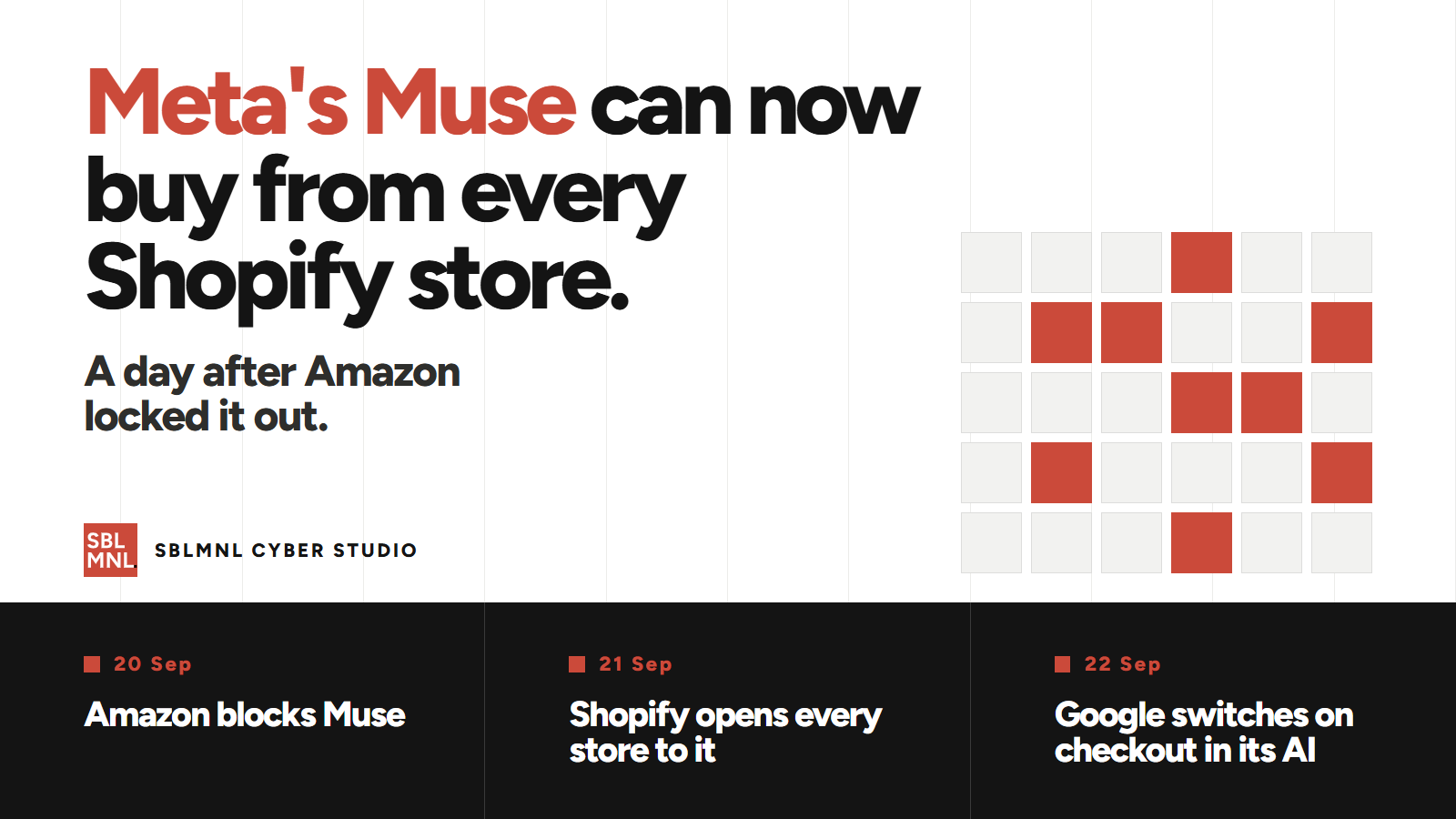
Agentic checkout lets an AI agent buy a product on a shopper's behalf, from finding it to paying for it. On 21 September 2026 Shopify switched it on for Meta's personal AI agent, Muse, across every Shopify store, a day after Amazon blocked Muse from shopping on Amazon.com. Shopify has spent the year building the pipes for AI shopping. In our view Muse brings what those pipes were missing: an AI agent living inside the apps billions of people already open every day.
Key takeaways
- On Sunday night, 20 September 2026, Amazon blocked Meta's AI agent Muse from shopping on Amazon.com. Amazon says Muse doesn't identify itself and appears to store customers' logins (GeekWire).
- The next day Shopify's CEO, Tobi Lütke, announced agentic checkout with Shop Pay for Muse "on all Shopify stores". Shopify's shares rose about 7% that day (Yahoo Finance).
- On 22 September Google told Shopify store owners that shoppers can now buy their products inside Google's AI search and the Gemini app without visiting the store's website. It is switched on unless the owner turns it off (Search Engine Roundtable).
- Muse runs in its own app and inside WhatsApp, in the US for now (Reuters). Meta's apps reach 3.60 billion people a day (Meta, Q2 2026).
- Until now few shoppers let an AI buy for them. OpenAI moved away from checkout inside ChatGPT in March 2026 after it failed to take off (CNBC), and 24% of consumers in a June 2026 survey said they would never let an AI make purchases for them (Checkout.com).
- Shopify says AI-driven traffic to its stores grew 8 times year on year in the first quarter of 2026, and orders from AI-powered searches grew nearly 13 times (Shopify).
Three days that split the biggest names in commerce
Meta launched Muse on 8 September as a personal AI agent that carries out tasks instead of answering questions. It can book travel, send email, fill in forms and buy things, and it pays through Link by Stripe with a single-use card number, so the shopper's real card stays hidden. Meta's launch post said "Shop Pay is coming soon".
Twelve days later Amazon shut Muse out. From Sunday night, anyone trying to buy on Amazon through Muse saw this message: "Continued access by an unauthorized AI agent violates Amazon's Conditions of Use, to which our customers have agreed."
On Monday, Tobi Lütke posted that Shopify is "partnering deeply with Muse to enable agentic checkout with Shop Pay on all Shopify stores". Mark Zuckerberg confirmed it within hours.
On Tuesday, Google made its own move. It emailed Shopify store owners who list their products on Google Shopping to say that people can now buy those products without leaving Google. A shopper asks Google's AI search or the Gemini app for something, picks a product and pays on the spot, and the order arrives in the store's Shopify account as normal. Google switched this on for every eligible store without asking first. An owner who wants every customer to finish buying on their own website has to go into Shopify and turn it off.
Why Amazon locked Muse out
Amazon's statement to GeekWire gives three reasons. Meta didn't tell Amazon that Muse would be shopping on its site. Muse doesn't identify itself as an AI agent when it browses. And it appears to capture and store customers' login details. Amazon contrasts this with its own agent, Buy for Me, which identifies itself and lets brands opt out.
Meta says Muse "has no visibility into people's passwords or payment methods", and that any credentials people share are kept in secure storage (Yahoo Finance).
There is also money at stake. Amazon earned more than $68 billion from advertising in 2025 (Amazon's fourth-quarter results), and that income depends on shoppers scrolling past sponsored listings on Amazon's own pages. An agent that buys without browsing never sees them. Amazon has already taken Perplexity to court over its Comet browser shopping on Amazon.
What Shopify had built, and what it was missing
Shopify has spent 2026 turning its stores into something an AI agent can buy from. AI assistants can now read a shared list of Shopify products, with each store's prices and stock, and complete a purchase through Shopify's checkout. Shopify and Google wrote a common set of rules so that any AI assistant can use a store's checkout and discounts without the store building anything new. Every eligible store also has a setting that lists its products in ChatGPT, Microsoft Copilot, Google's AI search and the Gemini app.
Shopify reports that AI-driven traffic to its stores grew 8 times in the first quarter of 2026 compared with a year earlier, and orders from AI-powered searches grew nearly 13 times. Those are growth rates, and Shopify hasn't said what share of its orders come through AI.
Shoppers have been slow to let an AI do the buying. OpenAI launched Instant Checkout in ChatGPT with Shopify and Etsy stores in September 2025, and moved away from it in March 2026 after it failed to take off. Today a ChatGPT shopper still finishes the purchase on the store's own website. In a June 2026 survey by Checkout.com across six markets, 24% of consumers said they will never let an AI make purchases for them, and 27% said they trust no organisation to run an AI shopping agent.
In our view, Shopify's agentic shopping plans were struggling to find customers. Most people didn't understand what agentic shopping was, it was hard to get to, and it felt risky, like an idea for the distant future. The stores were ready, and they were waiting for an agent people already trust in their everyday lives.
Why Muse changes the scale
That changed this week. Meta is the parent company of Facebook, Instagram and WhatsApp, and of its assistant Meta AI, and now of Muse. Its apps reach 3.60 billion people every day, and Muse sits inside WhatsApp as well as in its own app. Shopping through an AI no longer means finding and learning a new tool. It arrives inside an app people already open to talk to their friends and family.
Meta has also worked on the risk. Muse pays with a one-time card number, so the shopper's real card stays hidden, and Meta says it is the first AI agent covered by Link's purchase protections, including cover for damaged or lost items, price drops and no-fee returns on eligible purchases (Meta). When an agent that sits in your messages can buy from millions of Shopify stores and pay with Shop Pay, shopping by asking stops being an experiment for early adopters.
We think this is the partnership Shopify's plan for agentic shopping needed. Shopify supplies the stores, the product data and the checkout, and Meta supplies an audience that already opens its apps every day. Together they turn agentic commerce from a feature inside a chatbot into something ordinary people can do from the app they already use to talk to their friends.
Amazon's block makes the choice facing every retailer plain: Amazon wants the shopper and the sale on Amazon, while Shopify and Google are betting the sale will happen wherever the shopper is talking to an AI, and are opening the door to it by default.
What it means for a store in South Africa
Muse is only available in the US for now, and so is buying inside Google's AI. We think it is a matter of time before both reach South African shoppers and businesses, and Shopify says that when its AI partners expand to more regions, its merchants "will be ready by default" (Shopify).
Some of this already reaches South African stores. Any Shopify store that sells to US buyers can have its products shown in ChatGPT and Microsoft Copilot, wherever the store is based. For a South African brand that ships abroad, AI agents are already a live sales channel.
What decides whether an agent picks your product is your product data: complete titles, descriptions, variants, prices and stock that an AI can read and trust. We covered how South Africans already shop with AI and what your store tells AI agents. When Muse and native checkout arrive here, the stores whose catalogues are already ready will be the ones the agents recommend first.
Every store we build under Ecommerce Website Design is set up with that product data in mind. If you want to know how ready your store is, book a free call.
Frequently asked questions
What is Meta's Muse?
Muse is a personal AI agent from Meta, launched on 8 September 2026. It carries out tasks on a person's behalf, including booking travel, sending email and shopping, and it can pay at checkout. It is available in the US through its own app and WhatsApp, with a free tier and paid plans at $20 and $100 a month.
What is agentic checkout?
Agentic checkout lets an AI agent complete a purchase for a shopper, from choosing the product to paying for it. On 21 September 2026 Shopify enabled agentic checkout with Shop Pay for Muse on all Shopify stores.
Why did Amazon block Muse?
Amazon says Meta didn't tell it that Muse would shop on Amazon.com, that Muse doesn't identify itself as an AI agent when it browses, and that it appears to store customers' login details. Meta says Muse has no visibility into people's passwords or payment methods.
Can South African Shopify stores sell through Muse?
Not yet. Muse is only available in the US for now, and Shopify says its merchants will be ready by default when its AI partners expand to more regions. Shopify merchants anywhere who sell to US buyers can already be listed in ChatGPT and Microsoft Copilot through Shopify's Agentic Storefronts.