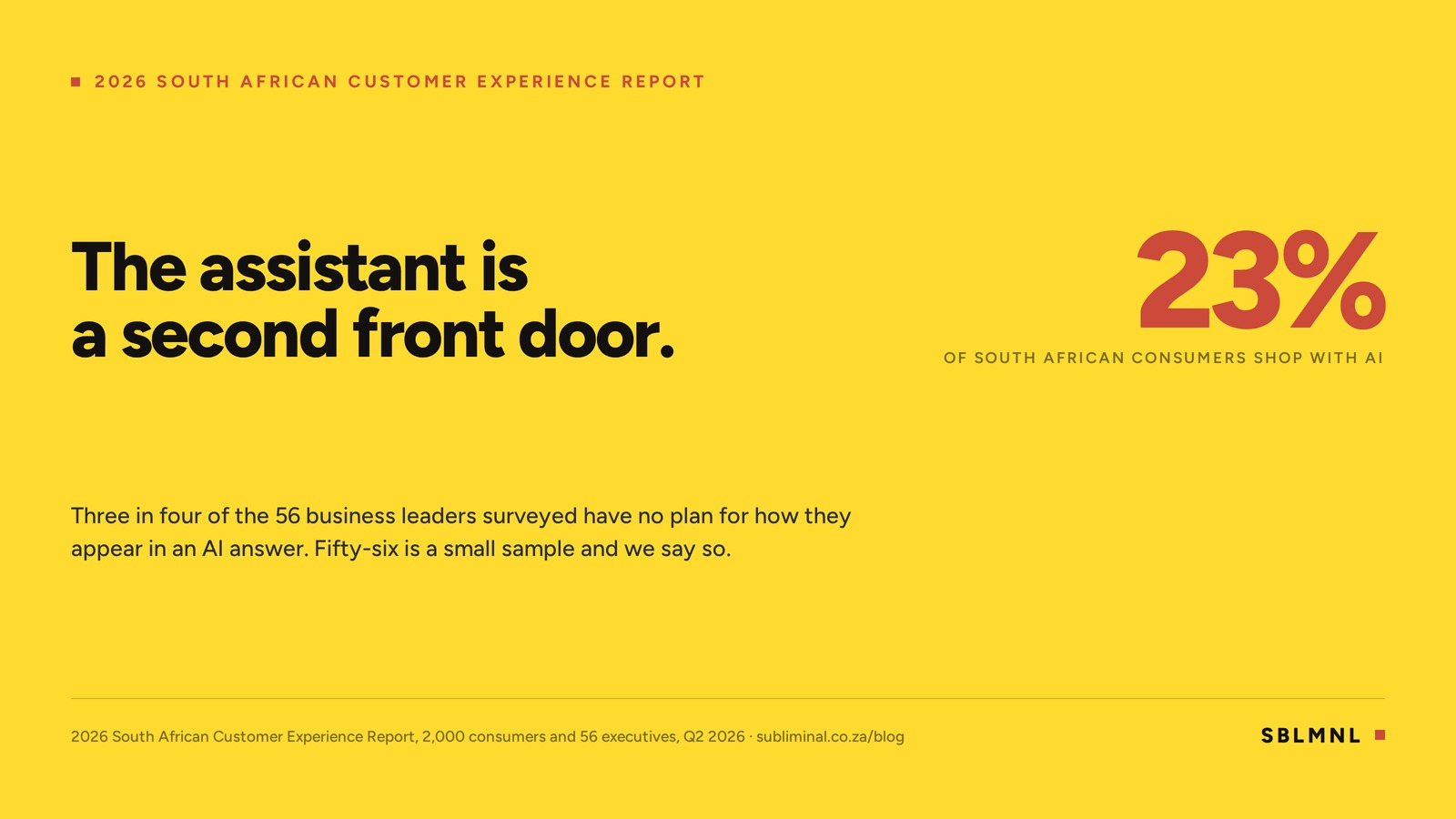
AI visibility is how completely and accurately an AI assistant can describe, price and recommend a business when a customer asks it for one. It is a separate question from where a business ranks on Google, and in South Africa it is now a measured one: nearly a quarter of consumers already put buying questions to an AI assistant, and three in four of the 56 business leaders surveyed alongside them have no plan for what those assistants say back.
Key takeaways
- 23% of South African consumers now use AI search tools such as ChatGPT, Gemini, Claude and Perplexity to compare products and prices, find deals and answer purchasing questions — more than double a year earlier (2026 South African Customer Experience Report, 2,000 consumers, fieldwork Q2 2026).
- In the same study, 75% of surveyed businesses have no active strategy for how they appear in AI-generated answers. That figure comes from 56 business executives, so treat it as a signal rather than a census.
- OpenAI has stepped back from selling inside the chat window. In its own words to merchants, it is "moving away from a standalone Instant Checkout experience in ChatGPT", so shoppers discover in the assistant and buy on the merchant's own site.
- ChatGPT shopping is currently live for users in the United States. A South African business is not being discovered there today, which makes this positioning work rather than revenue this quarter.
- Google still holds 92.12% of South African search (StatCounter, July 2026). The assistant is a second front door, not a replacement for the first one.
What the South African numbers actually say
The 2026 South African Customer Experience Report, now in its eighth year and produced by Rogerwilco with ovatoyou and CX consultant Julia Ahlfeldt, surveyed 2,000 consumers and 56 business executives in the second quarter of 2026. Almost one in four consumers, 23%, now use AI search tools to compare products and prices, find deals and answer purchasing questions. The report describes that as more than a doubling inside a single year.
The other half of the finding is the part most coverage skipped. Of the executives surveyed, 75% said their business has no active strategy for how it appears in AI-generated answers. Fifty-six executives is a small sample and we will say so rather than dress it up, but the direction is hard to argue with: consumer behaviour moved first, and the businesses on the other side of it have not moved yet.
A second audience, and it does not browse
Nate B Jones framed the shift neatly: we spent thirty years making companies legible to search engines, we are not finished, and there is now a second audience reading. The comparison earns its keep because the work rhymes — structured, accurate, machine-readable information about what you sell, what it costs, and what happens after someone buys.
It is worth naming where the analogy strains, because that is where people get sold things that do not exist yet. Search had one dominant gatekeeper and a rank you could check. With assistants there are several competing standards and no published position to check at all, which is why nobody can honestly guarantee a place in an AI answer.
Where the buying actually happens
Through late 2025 the story was that customers would buy inside the assistant. Stripe and OpenAI published the Agentic Commerce Protocol in September 2025 as an open, Apache 2.0 licensed standard for exactly that, and Shopify set about making every store agent-ready by default, syndicating catalogues into ChatGPT, Perplexity and Microsoft Copilot.
Then the direction changed, and OpenAI said so plainly on its own merchant page: it is "moving away from a standalone Instant Checkout experience in ChatGPT and prioritizing better shopping discovery and merchant-owned checkout experiences". Customers "discover and evaluate products in ChatGPT, but purchases are completed on merchant-owned websites or apps."
For a business owner that sentence says more than most coverage of this topic, and it points the opposite way to the hype. The assistant is becoming a shop window rather than a till, and what it puts in play is the recommendation.
What an assistant can learn about you today
Five questions decide whether a business is legible to an assistant: whether it can discover exactly what you sell, get a firm price without a human conversation, authenticate without borrowing someone's password, receive an output it can use, and produce proof that an authorised action took place. For most businesses selling online, the first two carry effectively all of the current value, and both are ordinary work.
Discovery is structured product data: complete titles and descriptions, identifiers, stock and shipping facts, and a robots file that permits the retrieval crawlers you want while you decide separately about the training ones. Price means a machine-readable number on anything genuinely transactable, which is where a page that hides its price behind an enquiry form quietly disqualifies itself. Neither is speculative: it is the same catalogue hygiene that SEO and Google's shopping surfaces already reward, which is why it is worth doing before anyone can prove the return.
The same test applies to a landing page. A page built purely for human persuasion, heavy on image and light on copy with the price behind a form, can be close to unreadable to something extracting text. Strip the visual layer away and what is left about the offer, the price and the terms is roughly what the assistant sees.
Frequently asked questions
How many South Africans use AI to shop?
23% of South African consumers now use AI search tools such as ChatGPT, Gemini, Claude and Perplexity to compare products and prices, find deals and answer purchasing questions, according to the 2026 South African Customer Experience Report, which surveyed 2,000 consumers in the second quarter of 2026. The report describes this as more than a doubling within one year.
Can customers buy from my business inside ChatGPT?
Not in South Africa, and increasingly not anywhere. OpenAI states on its merchant page that ChatGPT shopping is currently live for users in the United States, and that it is moving away from a standalone Instant Checkout experience in favour of discovery inside ChatGPT with the purchase completed on the merchant's own website or app.
What makes a business visible to an AI assistant?
Structured, accurate, machine-readable information: complete product or service data with identifiers, a firm price rather than an enquiry form on anything transactable, clear stock, shipping and returns facts, accurate business details, and a robots file that permits retrieval crawlers. It is the same catalogue and profile hygiene that search engines already reward, which is why the work pays either way.
Can anyone guarantee my business appears in AI answers?
No. Unlike search, there is no published ranking and no report that shows your position in an AI answer, so there is nothing to guarantee and nothing to verify a guarantee against. What can be managed are the inputs: what is publicly written about the business, how accurate and complete the data is, and whether the offer and the price are legible to something reading rather than looking.
Start with what an assistant says about you now
Ask an assistant to recommend a business in your category and area, then read what it says about yours. The gap between that answer and what is true is the work, and most of it is the same work that makes a site sell to people: accurate information, a clear offer, a price you are willing to publish. If the store itself is the weak link, that is an E-Commerce Website Build; if the profile and the answers around it are, that is Google Business Profile Management and SEO. Our earlier piece on zero-click search covers why the results page was already doing this before assistants arrived.