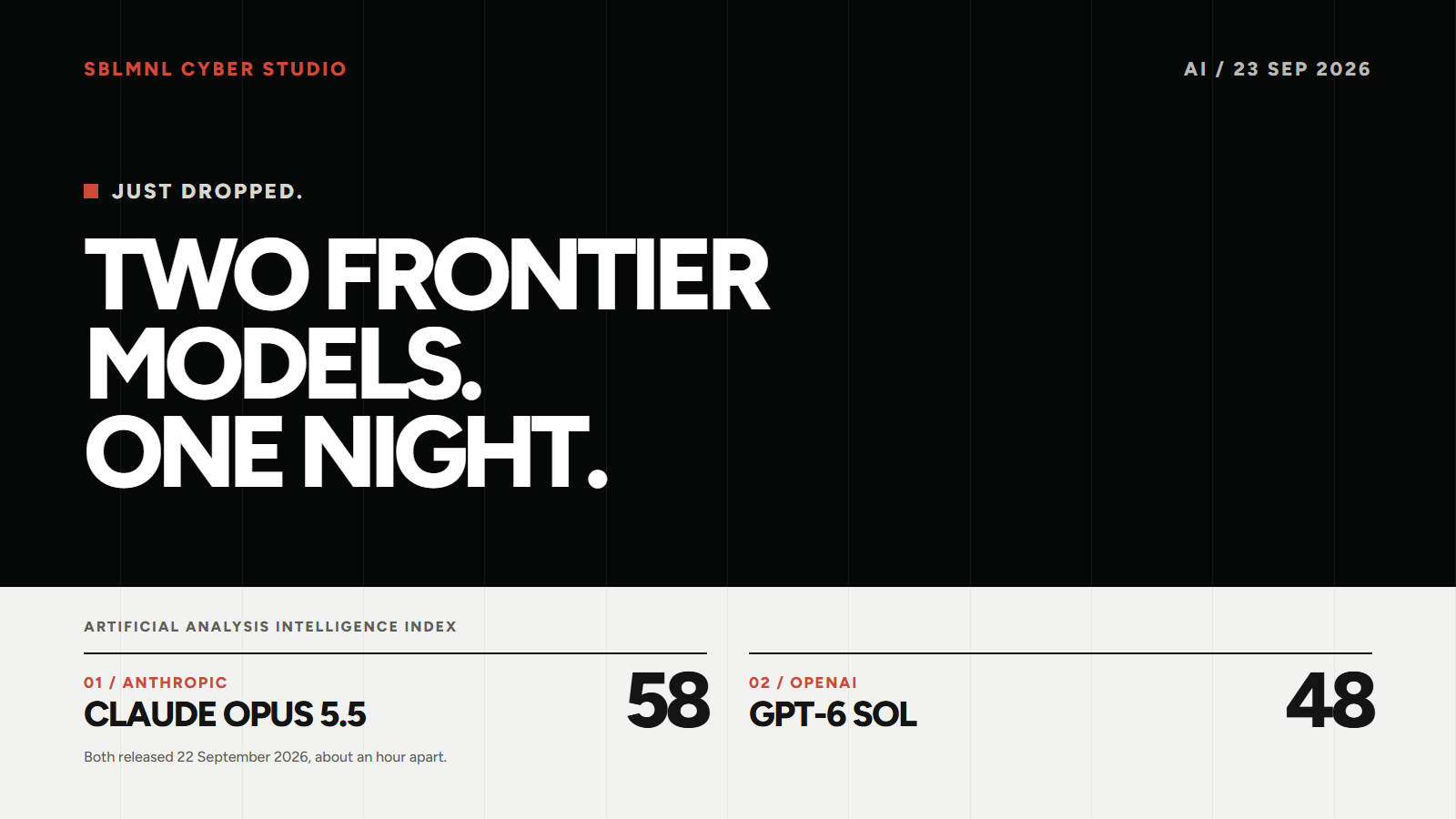
Claude Opus 5.5 is Anthropic's newest model, released on 22 September 2026, and it holds the highest score on the Artificial Analysis Intelligence Index, ahead of Anthropic's own flagship, Fable 5.1. OpenAI released GPT-6 Sol and GPT-6 Luna about an hour later. Neither lab announced its model in advance, so two new frontier models, the most capable class of model the big AI labs release, arrived on the same night with no warning. We read the night as Anthropic stamping its authority as the leader in frontier intelligence, while OpenAI focused on making the same work cheaper.
Key takeaways
- Anthropic released Claude Opus 5.5 on 22 September 2026. In Anthropic's launch table it outscores Fable 5.1, Anthropic's flagship, on all nine benchmarks listed, and Anthropic says it costs 40% less to run than Opus 5 on typical workloads.
- On the Artificial Analysis Intelligence Index, Opus 5.5 scores 58 at its highest setting. Fable 5.1 and OpenAI's GPT-6 Astra score 53, and GPT-6 Sol scores 48.
- Opus 5.5 costs $4 per million input tokens and $20 per million output tokens. Fable 5.1 costs $10 and $50 (Claude pricing).
- OpenAI's GPT-6 Sol costs $2 and $10 per million tokens, half the price of GPT-5.6 Sol. GPT-6 Astra remains OpenAI's frontier model.
- The launch came five days after Anthropic's redesigned Projects, while reports put the valuation Anthropic is targeting for its anticipated IPO at about $2 trillion.
What arrived on Tuesday night
Anthropic released Claude Opus 5.5 on Tuesday 22 September, in the evening South African time. About an hour later OpenAI released two models of its own, GPT-6 Sol and GPT-6 Luna, as 9to5Google and Simon Willison both reported. Neither company had announced a date beforehand, and nobody was expecting one new frontier model that night, let alone two. For anyone who follows AI, it felt like waking up on Wednesday to find it was everybody's birthday.
Opus sits one tier below Fable in Anthropic's line-up. Anthropic released Fable 5.1 on 1 September as its most capable model. Three weeks later the tier below has overtaken it.
Opus 5.5 beats Anthropic's own flagship
Anthropic's launch table sets Opus 5.5 against Fable 5.1, Opus 5, GPT-6 Astra and GPT-5.6 Sol on nine benchmarks. Opus 5.5 outscores Fable 5.1 on all nine and has the top score on seven. On Terminal-Bench 4.0, a test of AI agents writing code at a command line, it scores 66.4%, against 55.8% for Fable 5.1 and 57.9% for GPT-6 Astra. On GDPval-AA, a measure of everyday knowledge work, it rates 1846, against 1735 for Fable 5.1 and 1542 for Astra. GPT-6 Astra keeps the lead on two, business workflows and scientific research. Anthropic also says Opus 5.5 writes its output more than 30% faster than Opus 5.
The independent index agrees. Artificial Analysis combines many benchmarks into a single Intelligence Index. Opus 5.5 at its highest setting scores 58. The previous leaders, Fable 5.1 and OpenAI's GPT-6 Astra, both score 53.
The price went down. Opus 5.5 costs $4 per million input tokens and $20 per million output tokens, against $5 and $25 for Opus 5 and $10 and $50 for Fable 5.1 (Claude pricing). Anthropic puts the saving on typical workloads at 40% against Opus 5, because the model also needs fewer tokens to do the same job.
The saving is smaller at the top setting. Artificial Analysis records a cost of $5.98 to run its index on Opus 5.5 at maximum effort, against $7.63 for Fable 5.1. Simon Willison's own test found a limit too. On his usual drawing task, Opus 5.5 at maximum effort ran out of output space twice, at $2.56 an attempt, where Fable 5.1 finished.
OpenAI answered within the hour
GPT-6 Sol sits one tier below GPT-6 Astra, OpenAI's most capable model, and is meant for demanding work such as coding. GPT-6 Luna is for high-volume jobs such as summarising documents. Both cost half as much as the GPT-5.6 models they replace. Sol costs $2 per million input tokens and $10 per million output tokens, and Luna costs $0.10 and $0.50. Simon Willison points out that GPT-5.6 prices are due to rise by 25% in November, which widens the gap between the old models and the new ones.
On the Artificial Analysis index GPT-6 Sol scores 48, ten points behind Opus 5.5 and five behind OpenAI's own Astra.
The two launches had different aims. Anthropic's new model beats Fable 5.1, the flagship it released three weeks earlier. OpenAI's new model is cheaper than the one it replaces and does not reach GPT-6 Astra, which remains OpenAI's frontier model. In our view Anthropic used the night to stamp its authority as the leader in frontier intelligence, while OpenAI concentrated on making the same work cheaper.
Sol and Luna are available in ChatGPT Work and Codex for Plus, Pro, Business, Enterprise and Edu users, and Luna is in the desktop app for Free and Go users (9to5Google). Opus 5.5 is available in the Claude apps, on the Claude Platform, and through AWS, Google Cloud and Microsoft Azure.
What people built in the first hours
Within hours of the launch, builders were posting what they had made with Opus 5.5. Matt Wolfe's video roundup collected a Dark Souls-style action game and a flight simulator from the Forward Future team, a working Game Boy, and animations the model drew frame by frame in JavaScript. Wolfe said that a year ago he would have taken the Dark Souls clip for footage from a real game. He found almost no demos of GPT-6 Sol, and said most of what he saw on X was about Opus.
A dramatic month for Anthropic
Anthropic has had three major releases in three weeks. Fable 5.1 arrived on 1 September. On 17 September the redesigned Projects turned Claude into a coordinator that runs a team of agents. Opus 5.5 followed five days later.
All of this comes as Anthropic heads for the stock market. It has filed confidentially for its anticipated IPO, and reports this month put the valuation it is targeting at about $2 trillion, more than double the $965 billion set in its May funding round. CNBC confirmed in August that Anthropic told investors its annualised revenue run rate had reached $65 billion at the end of July.
We think this launch strengthens that case. Anthropic now holds the top independent score with a model that costs less than its own flagship, days after changing how work gets done inside Claude. The pace of these releases shows a company that intends to take more of the market and to stay the leader in frontier AI.
Frequently asked questions
What is Claude Opus 5.5?
Claude Opus 5.5 is an AI model from Anthropic, released on 22 September 2026. It sits one tier below Anthropic's flagship, Fable 5.1, and it outscores Fable 5.1 on all nine benchmarks in Anthropic's launch table. It scores 58 on the Artificial Analysis Intelligence Index, the highest score on that index.
How much does Claude Opus 5.5 cost?
Through the API, Opus 5.5 costs $4 per million input tokens and $20 per million output tokens. Opus 5 costs $5 and $25, and Fable 5.1 costs $10 and $50. Anthropic says Opus 5.5 costs 40% less to run than Opus 5 on typical workloads.
Is Claude Opus 5.5 better than GPT-6 Sol?
On the Artificial Analysis Intelligence Index, Opus 5.5 scores 58 and GPT-6 Sol scores 48. GPT-6 Sol costs less, at $2 per million input tokens and $10 per million output tokens.
What are GPT-6 Sol and GPT-6 Luna?
They are OpenAI's newest models, released on 22 September 2026, about an hour after Claude Opus 5.5. Sol sits one tier below GPT-6 Astra and is meant for demanding work such as coding. Luna is for high-volume tasks. Both cost half as much as the GPT-5.6 models they replace.
What it means for a business
The best-scoring model on the index now costs $4 per million input tokens, where the flagship it overtook costs $10. A business that already uses AI for writing or building gets the same work done this morning for less than it cost last week. The labs are also answering each other within hours, so a business should expect the leading model to change often and prices to keep falling. The race is heating up as the frontier models continue to pull ahead of the rest of the market.
The businesses that gain most are the ones that know which parts of their marketing AI should do and have written down how they want it done, whichever model is ahead. Working that out is a strategy question, and Marketing Strategy is the first of the five parts of the Growth Retainer. If you want to talk it through, book a free call.