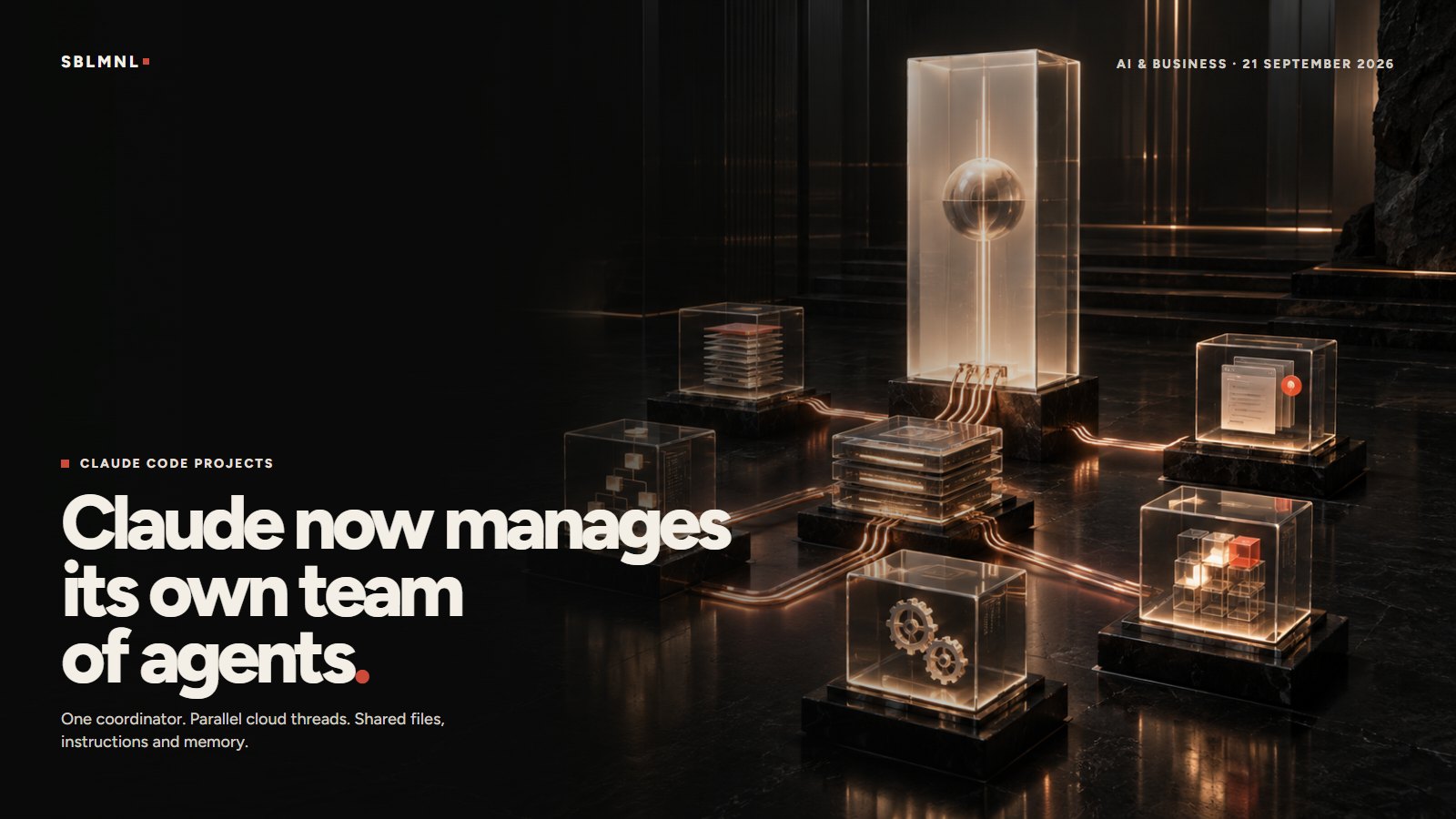
Claude Code Projects is a redesigned project experience from Anthropic, in beta since 17 September 2026, in which one ongoing conversation acts as a coordinator and starts a separate sub-agent, called a thread, for each task. The threads work in parallel in the cloud from the same files, instructions and memory, and they keep working after you close the laptop. It arrived five weeks after xAI launched Grok Bot. Developers had been building the same thing by hand since at least March.
Key takeaways
- Anthropic released the redesigned Projects in beta on 17 September 2026. A coordinator conversation starts a cloud sub-agent for each task and tracks them all.
- Every thread starts from the same repositories, files, instructions and memory, so a rule stated once reaches all of them.
- Developers were already doing this by hand. A write-up from 26 March 2026 documents the worktrees, shared memory files and handoff files they used.
- xAI launched Grok Bot, a chief of staff bot above a set of specialists, on 11 August 2026.
- CNBC confirmed that Anthropic told investors its annualised revenue run rate reached $65 billion at the end of July, against $40 billion at OpenAI.
- Access widens to more Pro and Max users of Claude Code this week. Chat, Cowork, Team and Enterprise follow.
What Anthropic shipped
Until now a Claude project was a folder of files with a chat attached. From 17 September it is a running conversation in which Claude acts as coordinator. You tell it what needs doing. It answers quick questions itself and starts a thread for anything that is real work, and each thread is a full Claude Code session running in Anthropic's cloud on its own branch. Anthropic sums it up in one line: "Projects have threads that do the work and a coordinator that directs them."
Every thread starts from a shared cloud workspace, which holds the project's repositories and uploaded files, written instructions of up to 16,000 characters, and a memory that Claude writes and reads itself. State a rule once, such as which branch to target, and every later thread starts with it. An Overview pane lists the threads that have finished, the ones still working and the ones filed under "Waiting on you". Work can be put on a schedule, and you can check in and steer from the Claude mobile app.
Anthropic markets it to developers, but the docs say a project does not need a code repository at all. Their own example is a folder of contracts, or an export of support tickets, that you keep returning to with new questions.
The fault it fixes
Every AI assistant on the market has shared one weakness. When a session ends, the assistant forgets it. Anyone pushing real work through one has had to split the job across sessions, repeat the background at the start of each, and join the results by hand.
Anthropic's announcement admits that managing several sessions "used to require you to divide the work, juggle handoffs, and stitch the results back together", and its docs call the old way "doing the coordinating yourself". Grok Bot runs on a cloud computer that stays switched on for the same reason.
Developers had already built it
The people who use Claude hardest had seen all of this before. On 26 March, six months before Projects, the engineer and author Addy Osmani wrote up how developers were running teams of coding agents by hand. Each agent got its own git worktree. Shared memory files collected what the agents learned, report files let one agent hand work to the next, and a row of terminal panes showed them all at once. He listed seven tools for orchestrating agents on a local machine, among them Conductor, Claude Squad and Vibe Kanban.
This studio is one of those builders. We were two days into scoping our own coordinator and specialist agents inside Claude Code when Projects shipped.
Why the built-in version wins
A hand-built agent stack is software, and somebody has to keep it running. The built-in version comes with the login, the plan and the memory a team already uses, and Anthropic maintains it.
The work builders put into their own rules is not lost. Project threads load the CLAUDE.md file, the skills and the plugins from every repository in the project, so the written rules and skills a team has built up carry straight over. The plumbing between agents is the only part Projects replaces.
A reply to Grok Bot
xAI, which now trades as SpaceXAI, launched Grok Bot on 11 August and described it as "your team of always-on agents". Its announcement says staff inside the company run several bots in parallel with one to manage the others, and adds, "A chief of staff sits on top, with a specialist for each lane." Five weeks later Anthropic shipped a coordinator above a set of threads. Both products run on cloud machines that carry on while the owner is away, and both hand every worker the same files and memory.
Anthropic has not said Projects is an answer to Grok Bot. We think it is. The two products share a structure and fix the same fault, and five weeks is a short gap between launches this alike.
CNBC confirmed in August that Anthropic had told investors its annualised revenue run rate reached $65 billion at the end of July, about seven times the figure a year earlier, which CNBC said underscored the popularity of its enterprise tools. The same report put OpenAI's run rate at $40 billion. That let Anthropic add a team of agents to a product its customers already pay for, while xAI has had to buy its audience. SpaceX completed its $60 billion acquisition of Cursor, the code editor, three days after Grok Bot launched, and its statement on the deal cited Cursor's "distribution to expert software engineers".
Where Anthropic is heading
Until now a Claude subscription has mostly bought access to one assistant at a time. With Projects, every thread is a full session drawing on the plan, so the bill starts to follow the amount of work done. The docs say a new project "runs every thread on Opus at high effort, which draws on your plan fastest", and that Claude starts as many threads as the work calls for, up to 200 new ones a day. Going past a plan's limits means paying for usage credits.
The launch came nine days after Claude subscribers filed an expanded class action, reported by Engadget, alleging that the Max plans deliver less usage than advertised. Anthropic had not responded to Engadget's request for comment.
A project that has spent three months learning a company's requirements, decisions and pitfalls is also hard to move to another vendor, which gives Anthropic a second reason to want that memory on its side.
A working day with a team of agents
A business that already runs on AI will send its work to one place as it arrives, whether that is a bug report, a list of tasks or a question about last month's tickets. Claude decides what becomes a thread and what it can answer on the spot. The owner comes back an hour later, or the next morning, to a list of finished work and a shorter list of decisions only a person can make.
The human effort moves to the brief and the review. A vague instruction is now multiplied across several agents at once, and there is more finished work to check afterwards. A business that has never written down how it does things will feel that gap first, since project instructions and memory are where a team of agents gets its rules.
Who gets it this week
Projects is in beta. Since 17 September it has been available to select Claude Pro and Max subscribers who use cloud sessions in Claude Code and have no existing projects on the web or desktop. Anthropic says it will "expand access to more Claude Code users on those plans" over the coming week, with "updated projects across all of Claude and Team and Enterprise plans" after that. Existing projects keep working as they do today and will be upgraded as the rollout reaches chat and Cowork. Pro and Max subscribers without access can join a waitlist.
During the beta, Projects runs at claude.ai/code, in the desktop app and in the mobile app, and is absent from the terminal. Threads run in the cloud only, so they cannot reach files or systems that exist only on your own machine or behind your network. Anthropic says that is "coming very soon". A project belongs to one user and cannot be shared, and there are no organisation-level controls yet.
Frequently asked questions
What is Claude Code Projects?
It is Anthropic's redesigned project experience, in beta since 17 September 2026. A project is one ongoing conversation in which Claude acts as coordinator and starts a thread for each task. Each thread is a Claude Code session running in the cloud, and all threads share the project's files, instructions and memory.
Who can use Claude Code Projects this week?
Select Claude Pro and Max subscribers who use cloud sessions in Claude Code and have no existing projects on the web or desktop. Anthropic says it will expand access to more Claude Code users on those plans over the coming week, with Team and Enterprise plans, chat and Cowork to follow. Others on Pro or Max can join a waitlist.
Is Claude Code Projects a reply to Grok Bot?
Anthropic has not said so. We think it is. xAI launched Grok Bot, a chief of staff bot above a set of specialist bots, on 11 August 2026, and Anthropic shipped a coordinator above a set of threads five weeks later to fix the same fault.
Can Claude Code Projects work with files on my own computer?
Not yet. Threads run in the cloud and work on GitHub repositories and on files you upload to the project. Anthropic says running on your own machine, alongside your local tools and behind your network, is coming very soon.
What comes after the beta
Anthropic has already signposted the next steps, which are threads running on local machines, projects reaching chat and Cowork, and Team and Enterprise plans. The move into chat and Cowork takes a team of agents out of developer tooling and puts it in front of everyone who uses Claude. We expect the other labs to match each step within weeks, as Anthropic matched xAI.
The businesses that get the most from this will be the ones with their written rules and files in order, whichever vendor is ahead in a given month. Deciding where tools like this belong in a business's marketing is a strategy question, and Marketing Strategy is the first of the five parts of the Growth Retainer. If you want to talk it through, book a free call.