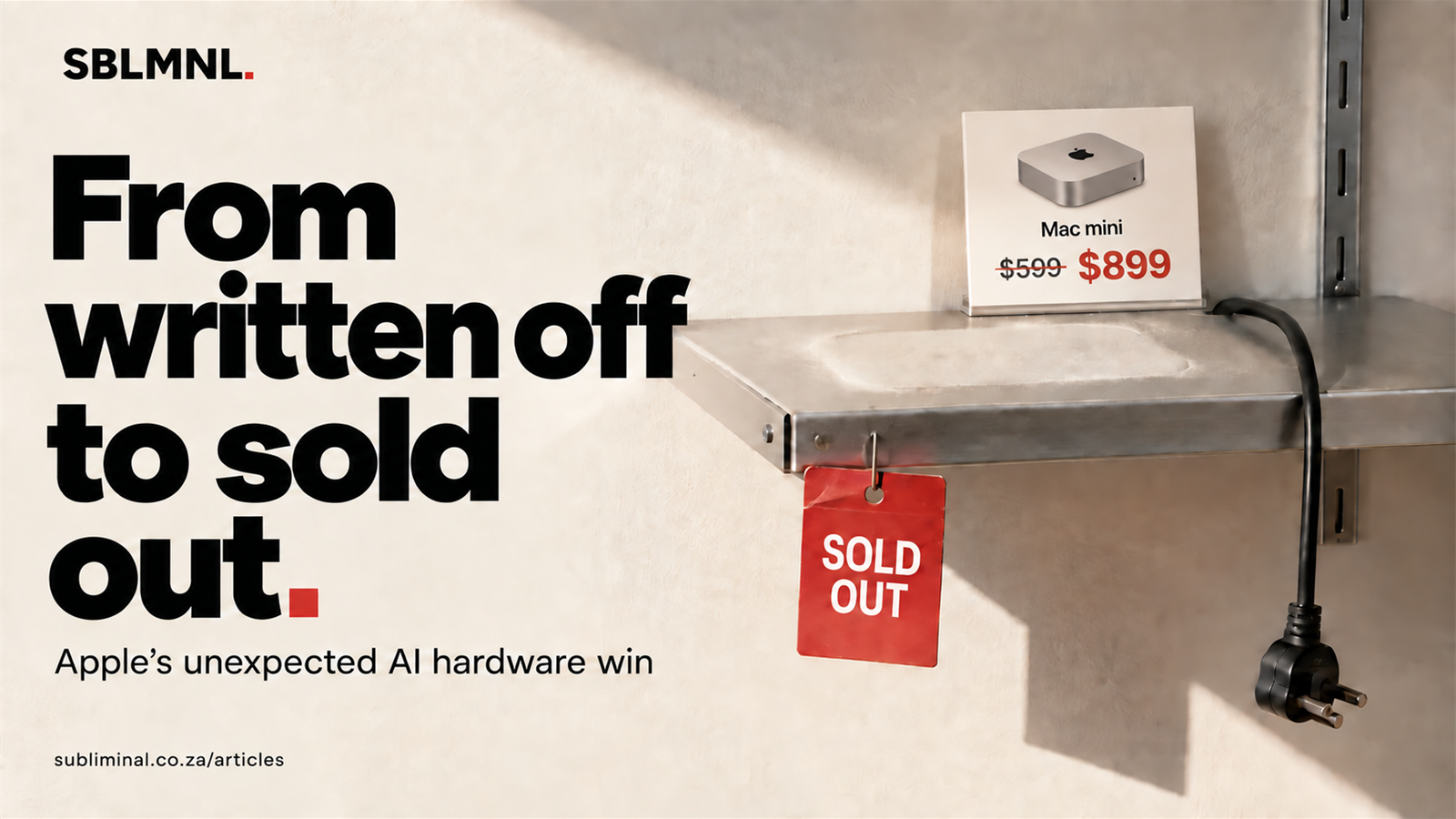
In 2025 Apple was the company that had missed AI. Microsoft, Alphabet, Amazon and Meta will spend more than $700 billion on capital projects in 2026, much of it on AI data centres. Apple spent $12.7 billion in its last financial year, and its Mac mini sold out anyway. It became the computer people buy to run AI agents of their own, and Apple had very little to do with why.
Apple was written off in AI
In December 2025 CNBC wrote that Apple had "so far been absent from the tech industry's AI race". Mark Gurman, Bloomberg's Apple reporter, had already called it "a half-decade late to the [AI] game". Siri's big upgrade had slipped a year, and investors had, in the words of Wedbush analyst Dan Ives, "gotten enough gray hairs waiting for Apple to come out with their AI strategy". The spending looked just as timid: $12.7 billion in the year to September 2025, less than Apple spent in 2018, against the $700 billion its four rivals will spend in 2026.
Developers bought up Mac minis for OpenClaw
OpenClaw is a free, open-source AI assistant that runs around the clock on a computer you own, and its users bought up the $599 Mac mini to run it on. Decrypt put it bluntly: "all it needed was some help from an open-source project Apple had absolutely nothing to do with."
By April the shelves were empty. Tim Cook told investors the Mac mini and Mac Studio were "amazing platforms for AI and agentic tools" and that customers had caught on "faster than what we had predicted". Upgraded Mac minis were quoted at 16 to 18 weeks and the 512GB Mac Studio vanished from Apple's store. OpenAI reportedly bought tens of thousands of Mac minis and Mac Studios to train its agents. In Arizona, a small online seller runs his business agent on a Mac mini, with the AI behind it rented from Anthropic and OpenAI. Bloomberg counts him as one of "several thousand small-business operators doing the same arithmetic".
What Apple did with the demand
Apple couldn't build Mac minis fast enough, so it raised the price. In May it stopped selling the $599 Mac mini once it sold out, and the starting price became $799. Demand did not let up, and business orders for AI hardware reportedly pushed Apple to bring its next Mac mini and Mac Studio release forward to the 25th of August. The latest Mac mini starts at $899 and runs on the M6, Apple's first chip made on its newest and smallest manufacturing process, with up to 32GB of memory. A version with the more powerful M5 Pro chip and up to 64GB of memory, room for larger AI models, starts at $1,699.
Apple now markets the new machines for AI by name. It calls the Mac mini "the leading desktop for always-on agentic computing" and pitches the Mac Studio as a way to run AI "without counting tokens or worrying about rising cloud costs". Apple's rivals pay to build the data centres that run their customers' AI. Apple's customers buy the computer that runs their own, so every Mac sold for AI earns Apple money instead of costing it.
How a Mac compares with other AI computers
A Mac isn't the cheapest way in. A Windows or Linux mini PC from about $750 can run OpenClaw if the AI behind it runs online, and computers built on AMD's Ryzen AI Max+ chip can run large AI models themselves for around $1,660. NVIDIA's RTX 5090 graphics card is faster than any Mac, but it holds only 32GB of memory, which limits how big a model it can run, and it sells for more than $4,300.
Where Apple wins is memory. The Mac Studio takes up to 512GB, enough to run huge AI models entirely on the machine, and in Tom's Hardware's test the newest one produced answers almost four times as fast as NVIDIA's DGX Spark, NVIDIA's own desktop AI computer. Federico Viticci, who reviews Apple gear at MacStories, ran his AI research assistants on his Mac instead of paying for cloud AI, at a total cost of nothing.
Rival Windows AI PCs arrive in October
In October NVIDIA and Microsoft start selling RTX Spark, a range of Windows computers built to run personal AI assistants at home. NVIDIA's announcement names OpenClaw, the same assistant that sent people to the Mac mini, so these machines are aimed squarely at Apple's new buyers. NVIDIA's chief executive, Jensen Huang, calls it "the new PC", and Microsoft's chief executive, Satya Nadella, is selling them as AI for every home and every desk, with no usage fees.
Apple has already lost some business buyers to NVIDIA. When the orders came in, Apple reportedly had no team dedicated to business customers and no plan for selling AI to them, and some companies bought NVIDIA's DGX Spark instead.
Apple's own most capable AI model, which its software chief, Craig Federighi, compares with Google's best Gemini models, was built with Google and runs on NVIDIA chips in Google's cloud. And many Mac mini owners use the machine only to keep their assistant running, while the AI doing the actual work is Claude or ChatGPT, online. The developer Simon Willison warns that "anyone who thinks local AI is going to save them money is likely to be disappointed, at least if they want to run models that are even remotely capable."
Apple got lucky with OpenClaw, then played the hand well. It sold the Mac mini as the machine for AI assistants and raised the price while the queues grew, and its rivals are the ones carrying the $700 billion bet. The first real test comes in October 2026, when NVIDIA's machines reach the shops.
If you want to talk about where AI fits in your business, book a free call.
Key takeaways
- Apple spent $12.7 billion on capital projects in fiscal 2025, less than it spent in 2018, while its four biggest rivals expect more than $700 billion in 2026.
- Developers bought up the $599 Mac mini to run OpenClaw, a free open-source AI assistant, and the Mac mini and Mac Studio sold out.
- Apple raised the Mac mini's starting price to $799 in May and to $899 on the new models it brought forward to August.
- NVIDIA and Microsoft ship Windows PCs built for personal AI agents in October.
Frequently asked questions
Why is the Mac mini popular for AI?
Apple's chips share one large pool of memory between the processor and the graphics, and AI models need a lot of memory to run. A $1,699 Mac mini holds up to 64GB, while NVIDIA's RTX 5090 graphics card holds 32GB and sells for more than $4,300. Even that Mac mini draws at most 145 watts, against 575 watts for the RTX 5090 card alone, so it can stay on day and night at little cost. That made it the natural machine for OpenClaw and other local AI assistants.
How much does Apple spend on AI infrastructure compared with its rivals?
Apple spent $12.7 billion on capital projects in fiscal 2025. Microsoft, Alphabet, Amazon and Meta expect more than $700 billion of capital spending between them in 2026, much of it on data centres.
Can a Mac run large AI models locally?
Yes. The Mac Studio offers up to 512GB of memory, and Apple says its newest model can "run huge LLMs with hundreds of billions of parameters entirely on device".
What is RTX Spark?
RTX Spark is a range of Windows computers from NVIDIA and Microsoft built to run personal AI assistants at home, on sale from October 2026.