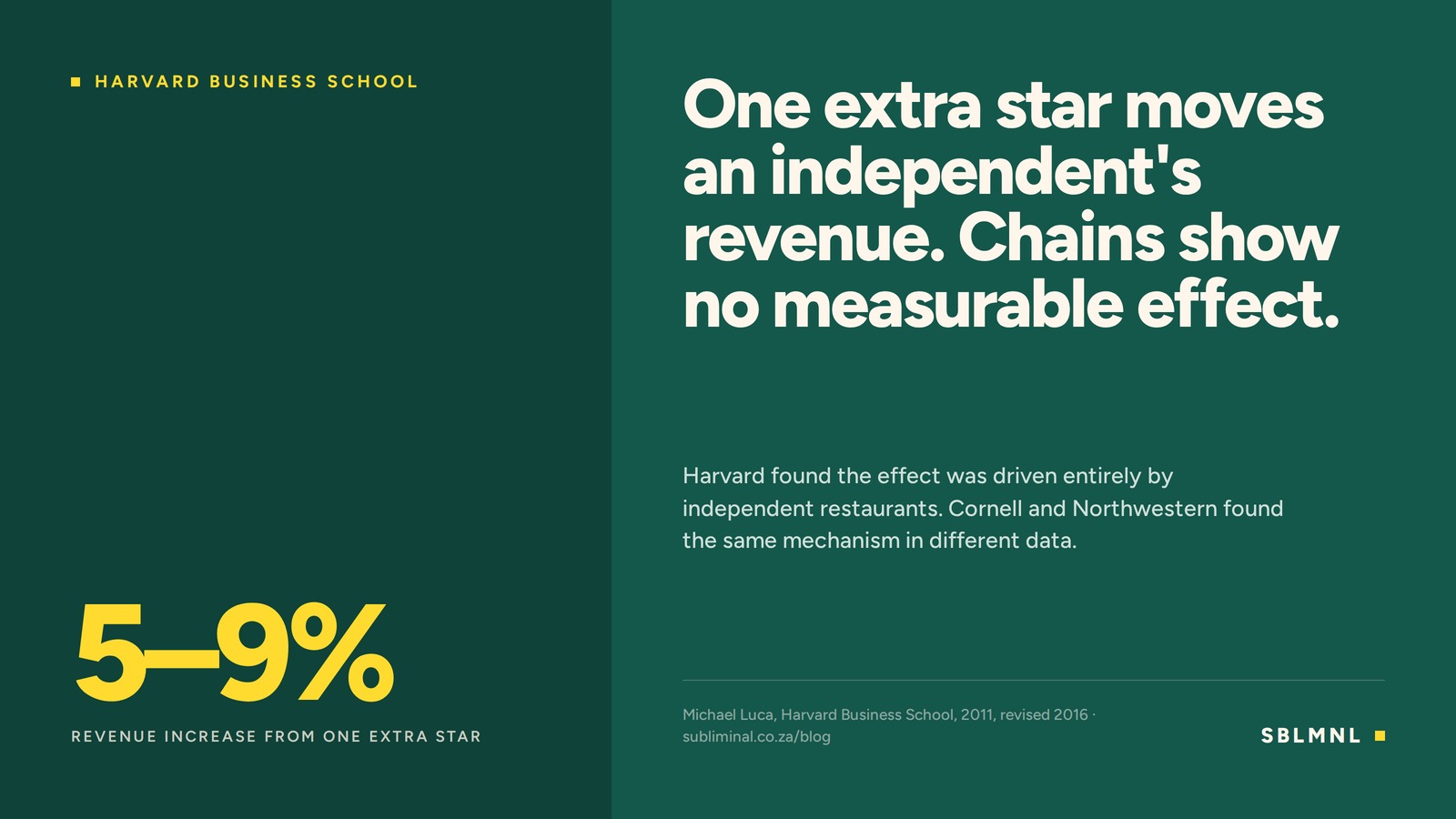
For an independent business, online reviews do the job that a national brand does for a chain — which is why Harvard research found a one-star rating increase lifts an independent restaurant's revenue by 5–9%, while chains show no measurable effect at all. That single finding, replicated in spirit by Cornell and Northwestern with different data, is the strongest evidence anywhere that reputation is not a soft metric. For businesses without a famous name behind them, it is the asset that moves money.
Key takeaways
- Harvard Business School research by Michael Luca (2011, revised 2016) found a one-star Yelp rating increase caused a 5–9% revenue increase, and that the effect was driven entirely by independent restaurants. Chains: no effect.
- Cornell's Center for Hospitality Research (2012) found a hotel that raises its review score by one point on a five-point scale can charge 11.2% more while holding the same occupancy.
- Northwestern's Spiegel Research Center (2017) found five reviews lift purchase likelihood roughly 270% over none, and that conversion peaks between 4.0 and 4.7 stars rather than at a perfect 5.0.
- The raw material is already there: in BrightLocal's 2026 survey, 94% of consumers said they're open to writing a review, and 83% of those asked went on to leave one. Only 69% actually wrote one.
- None of these studies is South African; we don't claim a South African revenue figure. The mechanism they identify, reviews substituting for brand reputation, is the part that travels.
The Harvard result: whose revenue moves
Most review statistics are surveys: people saying what they'd do. The Harvard study is different. Michael Luca matched Yelp ratings to actual restaurant revenue records held by the Washington State Department of Revenue, and used the way Yelp rounds scores to half-stars as a natural experiment: two restaurants with nearly identical underlying quality can display different stars, so the display's effect can be isolated from the quality's. That design is what lets the study say caused, not correlated.
Three findings came out. A one-star increase leads to a 5–9% increase in revenue. The effect is driven by independent restaurants, with no measurable effect for chains. And chain restaurants lost market share as Yelp's coverage grew. The authors' explanation ties it together: online reviews "substitute for more traditional forms of reputation". A chain's name already tells you what dinner will be like. An independent has no such asset, so its rating does that work instead.
Read that as a business owner and you have the moat argument in one line. A competitor can match your advertising budget next quarter. What they cannot do is instantly recreate years of customers saying, in public, that you're good.
Cornell: reputation is pricing power
The Harvard result is about volume of business. Cornell's Center for Hospitality Research found something arguably more valuable: price. Analysing matched transaction and revenue data for hotels in 2012, Chris Anderson found that a hotel raising its review score by one point on a five-point scale (say, 3.3 to 4.3) could raise its price by 11.2% and still hold its occupancy. Smaller improvements moved the dials too: each 1% gain in reputation score was associated with up to 0.89% higher average daily rate and up to 1.42% higher revenue per available room.
For any business whose model depends on rate integrity rather than discounting, in hospitality and well beyond it, that's the point: a strong, visible reputation doesn't just bring more customers. It lets you stop competing on price.
Northwestern: the first five reviews, and why 5.0 isn't the target
Northwestern's Spiegel Research Center analysed transaction-level purchase data in 2017 and found the heaviest lifting happens early: a product with five reviews was roughly 270% more likely to be purchased than one with none, with sharply diminishing returns after that. The lift was biggest where the stakes were highest, around 380% for higher-priced products against 190% for cheaper ones. High-consideration purchases are precisely where quality businesses live.
The same research holds a warning for anyone chasing perfection: purchase likelihood typically peaks between 4.0 and 4.7 stars, then declines as ratings approach 5.0. A spotless score reads as too good to be true. Spiegel's own advice is to "embrace negative reviews" for the credibility and authenticity they add. That is the performance case for something we hold as principle anyway: honest feedback, collected openly, with whether it goes public always the customer's call. (It's also a practical one: Whitespark's 2026 local-search survey lists reports of review gating as a Google Business Profile suspension-risk factor, and a profile that looks curated persuades nobody.)
The uncollected asset
If ratings move revenue, the next question is where the reviews come from. The answer, measured in BrightLocal's 2026 consumer survey, is encouraging: 94% of consumers said they're open to writing a review, 78% were asked for one in the past year, and 83% of those asked went on to leave one. Yet only 69% actually wrote one in the last twelve months. The willingness outruns the writing by 25 points. Most of the reviews your happy customers would write simply never get requested.
That gap is what a deliberate process closes: ask every customer, with the same ask, and reply to every published review with something specific. Volume matters as a filter too: in the same survey, 47% of consumers said they wouldn't use a business with fewer than 20 reviews.
What this means for a South African independent
None of these studies is South African, and we won't pretend to a local revenue figure nobody has measured. But notice what the mechanism needs to work: customers who read reviews before choosing, and businesses whose name alone doesn't settle the choice. Both conditions describe the South African market, where Google holds roughly nine in ten of the search-engine market (StatCounter, June 2026) and the businesses we work with compete on the quality of what they do rather than the size of their signage. The mechanism is the transferable part, and the asset it points to, a deep, honest, visible record of customers vouching for you, is one a competitor cannot buy quickly at any price.
Frequently asked questions
Do online reviews actually increase revenue?
Harvard Business School research by Michael Luca (2011, revised 2016) found that a one-star increase in a restaurant's Yelp rating led to a 5–9% increase in revenue, using a causal research design matched to official state revenue records. The effect was driven entirely by independent restaurants; chains showed no measurable effect.
Why do reviews matter more for independent businesses than for chains?
The Harvard study's explanation is that online reviews substitute for more traditional forms of reputation, such as national brand advertising. A chain's name already tells customers what to expect; an independent's rating does that job instead — which is why the rating moves an independent's revenue and leaves a chain's unchanged.
Is a perfect 5.0 star rating the goal?
The research suggests not. Northwestern University's Spiegel Research Center found purchase likelihood typically peaks at ratings between 4.0 and 4.7, then begins to decrease as ratings approach a perfect 5.0 — a spotless score reads as less credible. The same research recommends embracing negative reviews for the credibility they add.
How many reviews does a business need?
The first handful works hardest: Northwestern's research found a product with five reviews was around 270% more likely to be purchased than one with none, with diminishing returns after that. Volume still matters as a filter — in BrightLocal's 2026 survey, 47% of consumers said they wouldn't use a business with fewer than 20 reviews.
How much of your reputation is actually visible?
Most quality businesses sit on years of goodwill a searcher cannot see, and closing that gap is mostly a matter of asking. Reviews feed the Google Business Profile, which is where most of those searches land, and keeping it right is the job of Google Business Profile Management.