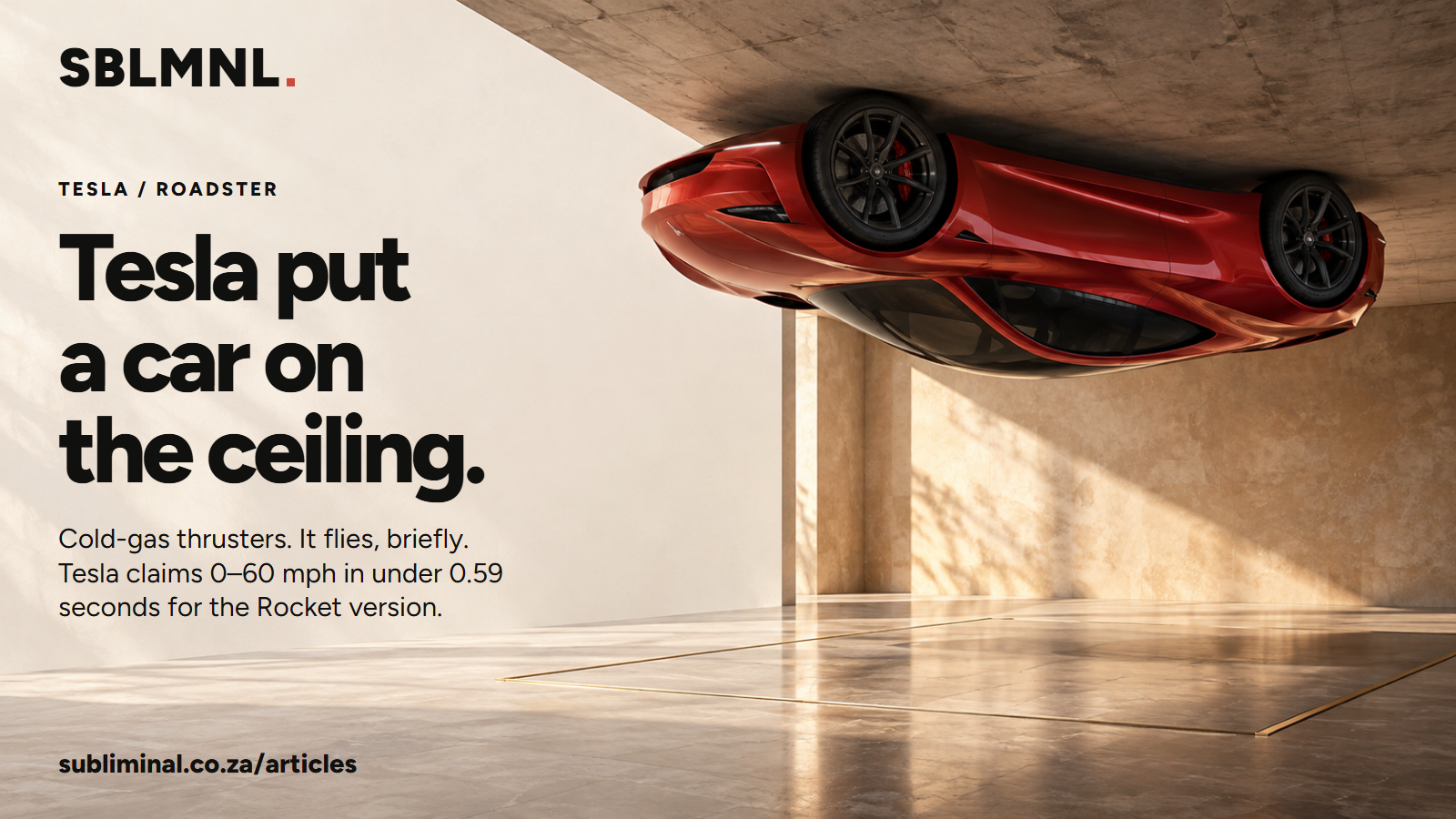
Tesla showed its new Roadster on the 15th of October 2026 at SpaceX's site in McGregor, near Waco, Texas. The car drove up a curved ramp until it was upside down, held there by fans pulling air from underneath it, then left the ramp, rolled in mid-air on jets of compressed air and landed on its wheels. In a second stunt it hopped clean over a Cybercab, a Cybertruck, a Semi, a Model Y and a Model 3.
For about a century, car engineers have worked on one problem above all others: keeping the car on the ground. Tesla has taken that problem and turned it upside down, quite literally, by bolting on two technologies from motorsport and spaceflight.
So we went through the footage and Tesla's own specifications to work out how a road car hangs from a ceiling, and what it means for the car people will actually be able to buy.
What Tesla showed at the Roadster reveal
The car climbed the ramp, hung upside down, let go, barrel-rolled and landed upright. For the second stunt it fired its thrusters and cleared five Tesla vehicles parked in a row. Elon Musk, Tesla's chief executive, summed it up afterwards: "Well, it worked."
Tesla hasn't said whether someone was at the wheel during the stunts or whether the car was driven remotely.
How a car sticks to a ceiling
The trick is air pressure. Fans under the car pull air out from beneath it, and a seal around the edges stops fresh air rushing back in. The air pressing on the top of the car is now stronger than the air underneath, so the car is pushed hard against whatever surface it is on. A suction cup on a window works the same way.
Racing tried this once. Brabham's BT46B "fan car" won the 1978 Swedish Grand Prix with a large fan sucking it onto the track, and it never raced again. Tesla calls its version a "multi-mode fan and ground sealing system". Lars Moravy, Tesla's vice president of vehicle engineering, says it produces up to 2G of suction. Holding a car to a ceiling takes just over 1G, so on paper there is plenty to spare. Tesla says the system is strong enough to hold the car upside down even while it's parked, something the night's demo didn't need to show.
What the suction means on the road
Hanging from a ceiling is the party trick. The real job of those fans is grip, and here the Roadster does something no wing can.
A wing makes downforce from the air rushing over it, so it only works at speed. At a crawl it does almost nothing. Tesla's fans make their own airflow, so the suction is there from the moment the car moves, and even when it doesn't move at all. In effect the car gets heavier against the road without getting any heavier to accelerate. Tesla describes two modes: a sealed, maximum-suction mode for low speeds, and a high-speed mode that opens air passages front and rear. An adjustable rear wing, moved by actuators borrowed from Tesla's Optimus robot, sets the balance between downforce and drag automatically.
The numbers Tesla gave are big. Musk says the suction can pull up to 2G, which Tesla says lets the car corner at more than 2G. A good road car on tyres alone manages around 1G before it starts to slide. Drive Tesla reported that the system produced more than 4,700 kg of downforce during the reveal, several times what the car weighs. That means more grip for cornering and braking, the tyres pressed into the road at speeds where other cars would already be sliding wide. Musk isn't shy about where that should lead: "It's gonna crush every track record that has ever existed."
Tesla calls it "the best passive downforce package of any road car". Like the other figures here, these are Tesla's numbers, and the proof will come when the car reaches a track with a stopwatch.
The flying comes from 10 cold-gas thrusters, the same idea spacecraft use to steer. Push compressed air out through a nozzle and the car moves the other way, like a balloon let go before it's tied. Tesla says "every usable void" in the car holds carbon-fibre-wrapped tanks to store that air, and the tanks can be refilled.
Three versions of the Tesla Roadster
- Performance: "road ready", two seats, active aerodynamics and the suction system, 0 to 60 mph in under 1.6 seconds.
- Thrust: "race ready", two seats, thrusters at the back, 0 to 60 mph in under 0.9 seconds.
- Rocket: "air ready", one seat, thrusters all around the body, 0 to 60 mph in under 0.59 seconds, by invitation only.
Tesla quotes more than 300 miles of range, a top speed above 230 mph and a measured 0 to 60 mph of 0.81 seconds. Musk says the production car will be quicker still, and his long-term goal is half the speed of sound, about 383 mph. These are Tesla's own figures, and independent tests will come once cars reach customers.
When the Tesla Roadster arrives
Musk says the Roadster will be built in 2028, and reservations have reopened at $50,000 for the Performance and $250,000 for the Thrust. Tesla hasn't announced the full price yet.
It has been a long road. Tesla first showed this Roadster in November 2017, and the version on stage is a very different car from the one revealed then, with the suction system and thrusters added along the way.
Why Tesla built a car that flies
Musk was open about what the Roadster is for. He said it may not "move the needle massively from a revenue standpoint". Sales were never the point of a car built in small numbers. It shows what Tesla's engineers can do when they borrow from SpaceX, the rocket company Musk also runs, and it puts that on video for the whole world to see.
It worked. The footage was everywhere by the next morning. A fan car was too much for Formula 1 in 1978, and nearly 50 years later Tesla has put one, with thrusters, into a car it plans to sell.
If you'd like to talk about getting your own launch seen, book a free call.
Key takeaways
- Tesla revealed its new Roadster on the 15th of October 2026 near Waco, Texas.
- The car drove upside down on a curved ramp using underbody suction fans, and used cold-gas thrusters to roll in mid-air and jump five Tesla vehicles.
- The suction fans give the car grip at any speed, even standing still. Tesla says they allow cornering at more than 2G, about twice what a good road car manages on tyres alone.
- Tesla lists three versions, Performance, Thrust and Rocket, with claimed 0 to 60 mph times from under 1.6 seconds down to under 0.59 seconds.
- Musk says the Roadster will be built in 2028. Reservations are $50,000 for the Performance and $250,000 for the Thrust.
Frequently asked questions
How does the Tesla Roadster drive upside down?
Fans under the car pull air out from beneath it while a seal around the edges stops air rushing back in, so the higher air pressure above presses the car against the surface. Tesla says the system produces up to 2G of suction.
What does the suction do for driving?
It presses the car into the road for more grip when cornering and braking. Because the fans make their own airflow, the grip is there at any speed, unlike a wing, which only works when the car is moving fast. Tesla says it allows cornering at more than 2G.
Can the Tesla Roadster fly?
It can make short hops. At the reveal it used cold-gas thrusters, which push compressed air out through nozzles, to roll in mid-air and to jump over five Tesla vehicles.
How much does the new Tesla Roadster cost?
Tesla hasn't announced the full price yet. Reservations are $50,000 for the Performance version and $250,000 for the Thrust version.
When will the Tesla Roadster be available?
Elon Musk says the Roadster will be built in 2028.