
AI adoption is the share of a team that actually uses AI in its daily work — not the number of licences a company has paid for. The two are confused constantly, and the distance between them is where most rollouts quietly stall: the seats get bought, the announcement goes out, and daily habits barely move. Zapier, the US software company, closed that distance with a move most businesses would never risk — it suspended normal work, across the whole company, for a full week, and spent the week building with AI. What followed is one of the clearest adoption curves any company has published.
Key takeaways
- In spring 2023, just after GPT-4's release, Zapier paused all work for a week and ran a company-wide AI hackathon — its CEO Wade Foster counts "360 Zapiens, 150 ideas, 60+ submissions", drawn from every function, not only engineering.
- It ended in a show-and-tell. In Foster's words on the GTM podcast: "We did a show and tell at the end of it, a demo day where people showed off."
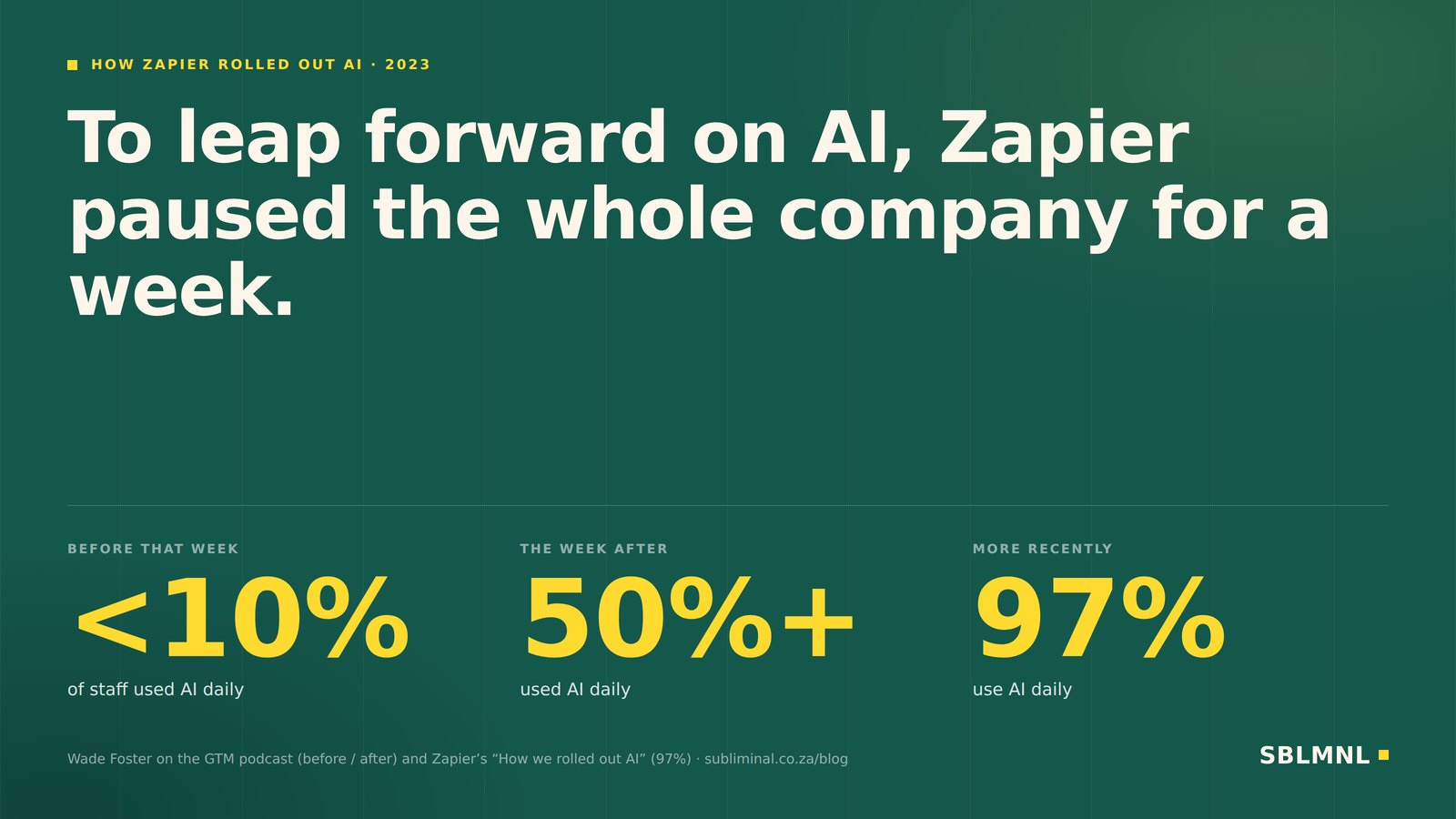
- Daily AI use jumped around that week. By Foster's account, it went from "just under 10%" of staff before it to "just north of 50%" after.
- Then it compounded: Zapier reports the share using AI daily reaching 63% in late 2023, 77% by the end of 2024, and about 97% more recently.
- The lever was visibility rather than the licence: a colleague demonstrating a working thing they built in a week removes the usual excuse of having no time to learn, and sends everyone home with real examples to copy.
What Zapier actually did
In March 2023, a fortnight after GPT-4's release, Zapier called an internal "Code Red" and paused all work for a week to run a company-wide AI hackathon. Foster's recap of the week counts "360 Zapiens, 150 ideas, 60+ submissions" — which is to say that within days, a meaningful share of a 360-person company had built something real with tools that were only weeks old.
The breadth of participation mattered as much as the pause itself. The people building, Foster said on the GTM podcast, were "not just engineering, but marketing and sales and HR and finance and all these functions" — and that detail carries the mechanism, because a hackathon confined to engineers teaches the engineers, while one that every function joins sends every department home with something it has watched work in its own corner of the business.
How the week ended
What gets retold about the week is the audacity of the pause, yet Foster's own telling puts the weight somewhere else. "We did a show and tell at the end of it," he said on the GTM podcast, "a demo day where people showed off" — and it is in that ending, more than in the time off, that the change in behaviour appears to live.
By Foster's account, "pre that hackathon week, there was probably just under 10% of folks using AI, like, daily for their work. And after it was just north of 50%." He hedges the figures the way any honest speaker hedges memory — "probably", "just under", "just north of" — but even read conservatively they describe a company in which daily AI use moved from a curious minority to a majority inside one week.
Why the demo day moved the number
Most organisations introduce AI the way they introduce any new tool: the licences are bought, the announcement is sent, and the training is linked. Very little of that changes what anyone does on a Tuesday morning, because all of it asks people to take somebody else's word that the new thing deserves their limited time.
A demonstration from a colleague works on different terms. It comes from somebody with the same job and the same time pressures, which quietly removes the most respectable excuse for not trying — a peer, visibly, just found the time — and it replaces the abstraction of an announcement with a concrete, copyable example. Zapier's week produced more than sixty of those, which meant everyone walked out carrying working proof rather than an instruction to experiment.
Adoption compounds — when the proof keeps coming
The week turned out to be the start of a much longer curve: Zapier reports daily AI use reaching 63% of the company in late 2023, 77% by the end of 2024, and hovering around 97% more recently. A one-off event cannot produce that trajectory by itself, and the more plausible reading is that the same principle kept running — people seeing, in the open, what their colleagues were actually getting done with the tools.
Scope is worth stating plainly here. This is one company's documented experience rather than a market statistic, and Zapier is a software business whose staff were always likely to take to these tools quickly. What transfers is not the percentage but the mechanism — people adopt what they can watch working long before they adopt what they are told about.
What this means if you're weighing up AI
For a business sitting on the question of whether, and how, to bring AI into its work or its marketing, the lesson translates without much strain. The strategy document, the committee and the mandate can all come later; what starting actually requires is one visible win — a single real task done measurably better, somewhere the result can be watched rather than taken on faith.
That, for what it is worth, is how we prefer to work too: everything we build is judged on what it produces — enquiries, sales, calls — rather than on what was promised in the pitch, and a Landing Page Build and Optimisation makes a natural first visible win, being one page, built to convert, with its result plainly in view within weeks. If you are weighing up where your own first win should come from, that is exactly the conversation a free call is for.
Frequently asked questions
What was Zapier's AI hackathon?
In spring 2023, shortly after GPT-4's launch, Zapier paused normal work for a week and ran a company-wide AI hackathon. Around 360 staff took part across every function, producing 150 ideas and more than 60 submissions, and it ended with a demo day where teams showed what they had built.
How much did AI use increase after Zapier's hackathon?
By CEO Wade Foster's account, daily AI use at Zapier went from just under 10% of staff before the hackathon week to just north of 50% immediately after it. Zapier later reported the share using AI daily reaching 63% in late 2023, 77% by the end of 2024, and about 97% more recently.
Why did a demo day drive AI adoption?
Because visible proof from a peer is more persuasive than an instruction from management. When colleagues demonstrate working things they built themselves, the idea that there is no time to work it out is harder to sustain, and everyone leaves with concrete examples they can copy rather than an abstract encouragement to try.
How can a business start using AI?
Begin with one visible win rather than a broad strategy: a single real task done measurably better, where the result can be seen rather than assumed. A small, working example tends to drive more adoption than a licence and an announcement, for the same reason Zapier's demo day did.